A typical Sunbury patient walks in with active gum disease and one goal: fixed teeth. The path from one to the other is not a single appointment. It is a sequence of stages, and the timeline depends on what we find at consultation.
The short answer is that gum disease does not rule out dental implants. It does have to be brought under control first, and what counts as controlled determines how long the full sequence takes.
Some patients move from consultation to final teeth in three months. Others need closer to twelve. Both are normal pathways. Which one applies to you is decided by what your gums and jawbone show on the first day.
Stage 1. Assessment and Staging
The first appointment is an evaluation, not a procedure. 3D imaging maps the bone, and a periodontal examination measures the gums. Together they answer two questions: what stage is the gum disease at, and how much bone has been lost, if any.
Gingivitis, the earliest stage, affects only the gum tissue and is reversible. Mild to moderate periodontitis involves some bone loss around the teeth. Advanced periodontitis involves significant bone loss and often unstable teeth. Each stage changes the treatment sequence, and the timeline along with it.
This stage typically takes one to two appointments over one to two weeks, depending on diagnostic complexity.
Stage 2. Gum Stabilisation
Active gum disease and implant placement are not compatible. Implants are placed into bone, and bone integration depends on healthy surrounding tissue. So the next step is to bring the gum disease under control.
For early to moderate cases, this usually means non-surgical periodontal therapy. Deep cleaning, scaling and root planing remove the bacterial colonies sitting below the gumline. Reassessment follows after four to six weeks of healing.
For advanced cases, surgical periodontal treatment may be needed to access bone surfaces that non-surgical methods cannot reach. Reassessment in these cases typically extends out to eight or twelve weeks.
Stage 2 is the variable one. Mild cases stabilise in four to six weeks. Advanced cases take twelve weeks or longer to reach a stable enough baseline for implant planning.
Stage 3. Bone Preparation, If Required
Gum disease causes bone loss. When enough bone has been lost, an implant has nothing reliable to anchor into. This is where bone grafting comes in.
Not every patient needs it. Whether you do depends on which teeth are affected, how much bone has gone, and which implant approach is planned. A single missing tooth in an area of significant bone loss usually requires grafting before placement. The graft itself heals over three to six months before the implant goes in.
This is also the stage where the All-On-4 Plus® protocol changes the conversation. Because All-On-4 Plus® uses four longer implants angled to engage denser bone in different regions of the jaw, many patients with moderate bone loss can avoid grafting.
The protocol can sometimes proceed from gum stabilisation directly to implant placement, removing several months from the total timeline. Where bone grafting is required, it is accounted for within the quoted treatment fee at Couture Implant Centre rather than billed separately.
If grafting is required, add three to six months. If not, this stage is skipped entirely.
Stage 4. Implant Placement and Final Teeth
This is the stage most patients picture when they think about implants. The surgery itself happens in one appointment. The restoration timeline after that depends on which type of implant treatment you are having.
For single implants and conventional implant bridges, the implants are placed and then left to integrate with the bone for three to six months before the final crown or bridge is attached. This wait gives the bone time to fuse around the titanium surface.
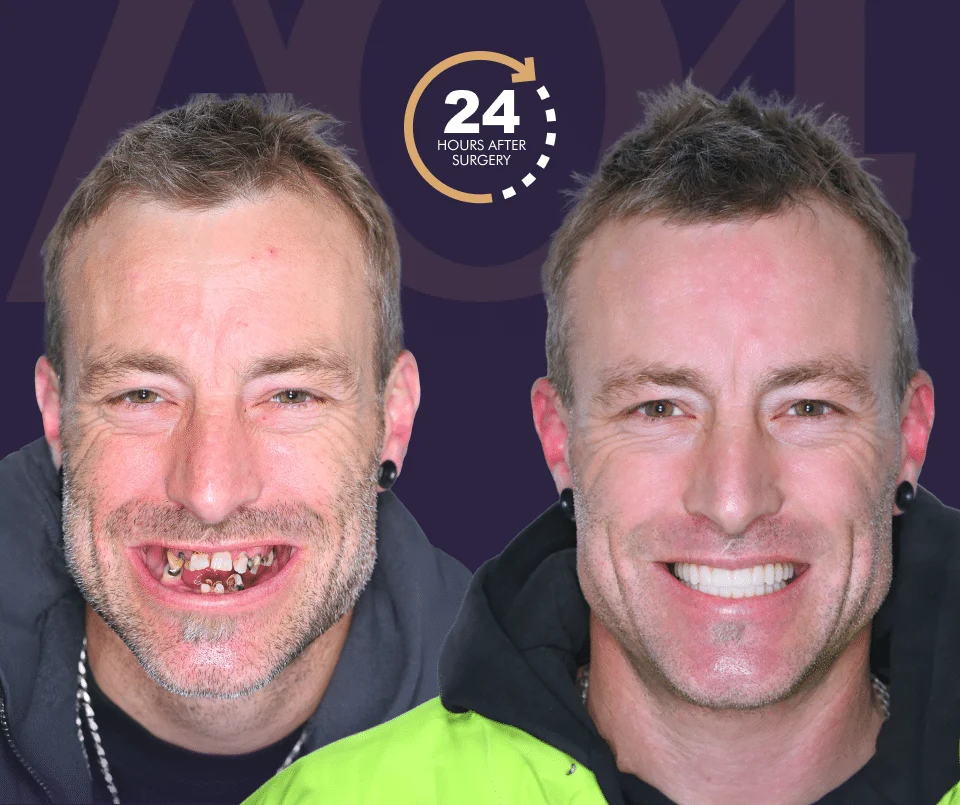
For All-On-4 Plus®, the timeline is shorter. Surgery, immediate teeth and a working bite are typically achieved within 24 to 48 hours of the procedure. Final restorations follow several months later once healing has settled.
This is a surgical procedure. Treatment carries risks, which will be discussed during your consultation.
Which Pattern Fits Your Situation
Three patterns are common.
The fastest sequence runs about three months. Mild gingivitis only, no significant bone loss, an All-On-4 Plus® pathway with no grafting required. Consultation, gum stabilisation, surgery with immediate teeth, settled. This is the patient who arrives early in the disease process with a single full-arch decision to make.
The middle sequence runs six to nine months. Moderate periodontitis, some bone loss, a mix of grafting and All-On-4 Plus® planning. The longer pathway accommodates healing time between gum treatment and surgery, but the immediate-load aspect of All-On-4 Plus® can still save several months overall.
The longest sequence runs twelve months or more. Advanced periodontitis, substantial bone grafting required, and a single-implant or implant-bridge plan for several teeth. Each implant integrates over three to six months before its crown attaches. This is also the pattern for patients who want to retain natural teeth alongside replacement implants and prefer a phased approach.
The single most useful thing the first consultation produces is not a treatment plan. It is a realistic timeline. Once you know which pattern applies to you, the rest of the decisions get easier.
Why Choose Couture Implant Centre
Three things have the most bearing on the gum-disease-to-implant timeline, and Couture Implant Centre is set up around them.
Dr Fong has completed more than 3,000 All-On-4 Plus® procedures, including full mouth rehabilitation cases. Patients with gum disease histories are a recurring part of that caseload, not an exception.
The full surgical and recovery infrastructure sits inside one Sunbury location, including general anaesthetic facilities where appropriate. There is no separate hospital arrangement to navigate, which removes scheduling time between providers for many patients.
Where bone grafting is required, it is accounted for within the quoted treatment fee. The first consultation produces a documented sequence with realistic stage durations, so you know what you are committing to before any treatment begins.
Ready to map your own timeline? Reserve a complimentary consultation with Couture Implant Centre and walk away with a realistic sequence, not just a quote.