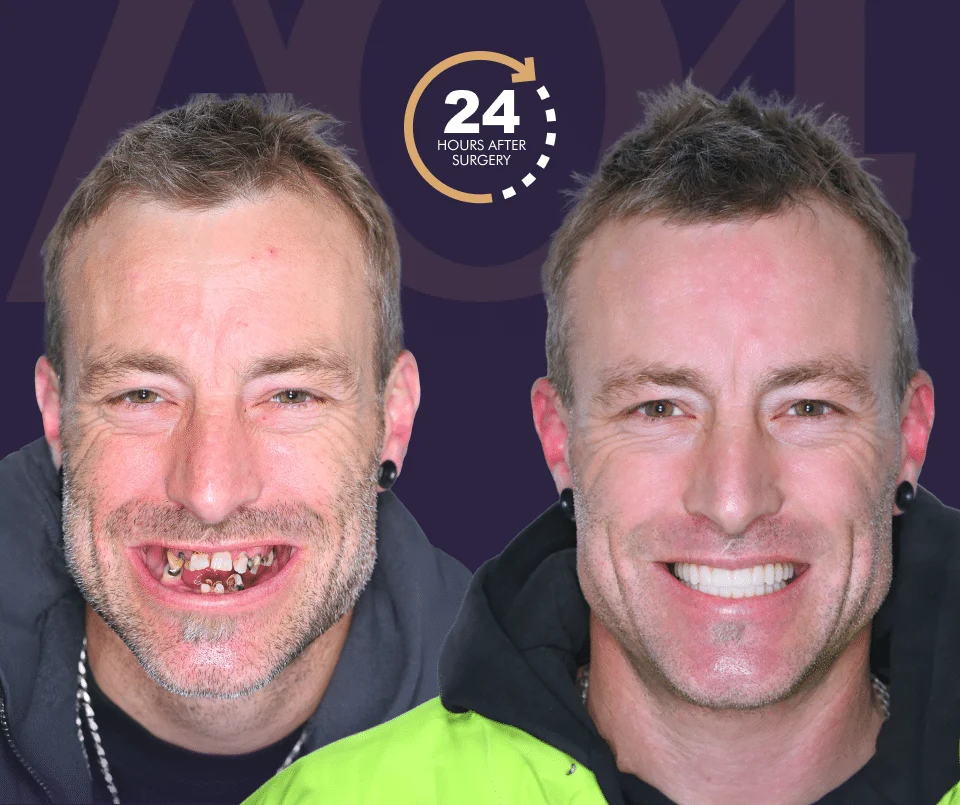
A significant portion of the work Dr Fong handles at Couture Implant Centre™ is not new surgical cases. It is rescue work. Patients arrive in Sunbury or Melton having seen one, two, sometimes three previous clinicians, after an earlier budget All-on-4 or treatment completed overseas has failed. Below is an outline of why these failures happen and what rescue treatment involves.
The Patterns We See Most Often
When patients arrive for a rescue consultation, the underlying causes are usually familiar, regardless of which country or clinic delivered the original treatment.
Implants That Have Not Integrated
Established implant systems are backed by decades of clinical research and consistent manufacturing standards, and generic or copycat systems often are not. We commonly see cases where one or more implants never fully integrated with the bone, leading to movement, infection, and eventual loss. The visible failure is the loose bridge, but the underlying issue is often the hardware chosen years earlier.
Bridges That Have Snapped
The second common pattern is the bridge itself fracturing. In most of these cases the bridge was built without an internal titanium superstructure. With nothing rigid distributing the force of chewing across the arch, the acrylic or basic plastic eventually flexes beyond its limit and breaks, leaving the patient with a partial result.
Treatment Completed Overseas
The appeal of overseas surgery is the headline price. The practical difficulty is follow-up care. If something changes six months later, the original clinic may be hard to reach, and local clinics may not be able to source components compatible with the system that was used. Where that happens, rescue treatment can mean lost bone, a longer treatment timeline, and a higher overall investment than the original quote suggested.
How We Approach Rescue Cases
Rescuing a failed full-arch case is more complex than completing the work correctly the first time. It can involve scar tissue, reduced bone volume, sometimes nerve sensitivity, and a patient who has lost confidence in the process. It takes careful planning and patience.
Specific Protocols Built From Experience
With more than 3,000 arches of experience, Dr Fong and the team have developed specific protocols for removing failing hardware safely, managing the surrounding tissue, and rebuilding the foundation. Depending on your case, that may involve staged treatment using single implants, multiple implants, an implant bridge, or a full reset using immediate implants once the foundation is ready.
Re-Engineering, Not Patching
Rather than patching the existing work, we plan the arch again around our AO4 Smile Dental Implant System, with a titanium superstructure inside the bridge and research-backed implants below. Combined with our dental technicians’ 20 plus years of experience and high-impact materials, the aim is stability, function, and an appearance appropriate to your case. For patients who find the process difficult after a previous experience, sleep dentistry with general anaesthesia is available so the surgical phase happens while you are asleep. General anaesthesia carries its own clinical considerations, which the team will discuss with you beforehand.
A Second Opinion Worth Having
If you are unsure whether a rescue is even possible in your case, that uncertainty is exactly why a thorough assessment matters. A focused review of your scans, your hardware, and your overall oral health usually clarifies what can and cannot be done in your situation.
Talk to Us About Your Case
If you are dealing with a failing implant, or with a result from treatment elsewhere that has not held up, visit Dr Fong and the team at our Sunbury or Melton centre and let us review your case. Call 03 8338 4377 or book your complimentary consultation online.